


The One Word in a Science Question That Can Change the Entire Answer

A student can know the science, remember the formula, and still lose marks because of one small word in the question. It happens more often than many parents realise. In GCSE Science, words such as state, describe, explain, compare, calculate and evaluate are not just instructions. They tell the student exactly what kind of answer the examiner expects. If your child misunderstands that word, they can give a scientifically correct response and still miss the mark. This is one of the reasons some students leave an exam saying, “I knew that topic,” yet the result does not reflect what they expected. The problem is sometimes not their scientific knowledge. It is how they read and respond to the question.
Why Command Words Matter So Much
Science exam questions are carefully written. The command word tells the student what they need to do with the information they know. For example, imagine a question asks a student to state one function of red blood cells. A short, direct answer is enough. They may write that red blood cells carry oxygen around the body. Now imagine the question asks them to explain how red blood cells are adapted to carry oxygen. The answer needs much more detail. The student may need to mention haemoglobin, the lack of a nucleus, and how these features help the cells carry more oxygen. The topic is still red blood cells, but the command word has changed the whole answer. This is why simply memorising facts is not enough for strong science results. Students need to know what to do with those facts when they see different exam questions.
“Describe” and “Explain” Are Not the Same
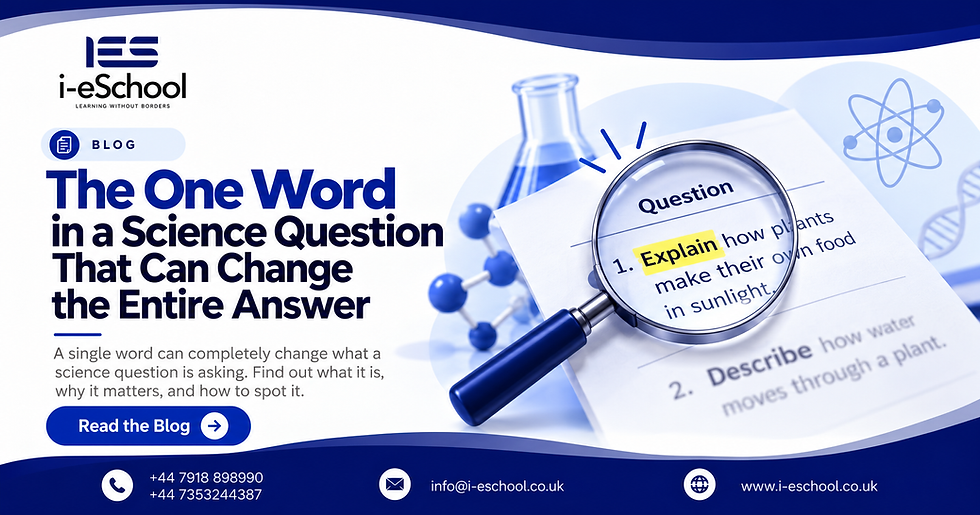
This is one of the most common areas of confusion. When a question says describe, the student usually needs to say what happens, what they can see, or what the pattern is. If they are looking at a graph, they may need to describe how one variable changes as another increases. When the question says explain, they need to go further. They must give the reason why something happens. For example, a student might describe a graph by stating that the reaction rate increases as the temperature rises. If asked to explain this, they would need to mention that particles have more kinetic energy, move faster, and collide more often with sufficient energy to produce a successful reaction. A student who only describes when asked to explain may understand the topic well, but still loses marks.
“Compare” Needs Both Sides
Another word that catches students out is compare. When students see this word, some write everything they know about one thing and then everything they know about the other. That can lead to long answers with very few marks. A comparison needs clear similarities or differences. If a question asks students to compare mitosis and meiosis, a stronger answer might say that mitosis produces two genetically identical cells, while meiosis produces four genetically different cells. The important word there is while. It shows the examiner that the student is making a direct comparison. Teaching children to look for both sides of a comparison can immediately improve the quality of their answers.
“Calculate” Requires More Than the Final Number
Physics and Chemistry questions often use the word "calculate," which brings another common problem. Some students rush straight to the final answer. If they make one small mistake, they may lose several marks. A better approach is to show the formula, substitute the values, carry out the calculation and include the correct unit. For example, if a student is calculating speed, writing the formula first can help them organise their thinking:
Speed = distance ÷ time.
Even if the final answer is wrong because of a small arithmetic mistake, showing the correct method may still earn marks. This is especially important in Physics, where method marks can make a big difference.
“Evaluate” Means Looking at More Than One Side
The word evaluate usually appears in questions that require students to consider evidence, strengths, weaknesses or different options. These questions often carry more marks, but students sometimes give a simple opinion instead. If a question asks them to evaluate a method, they may need to discuss what works well, what could go wrong and how the method could be improved. If they are evaluating evidence, they may need to consider whether the data is reliable and whether there is enough information to support a conclusion. The key is to avoid jumping straight to a judgement. A strong evaluation gives reasons before reaching a conclusion.
How Parents Can Help at Home
Parents do not need to become science teachers to help with this. One of the simplest things you can do is encourage your child to underline or circle the command word before answering a question. Then ask them, “What is this question actually asking you to do?”
You can also take a few past-paper questions and compare the command words. Look at how the expected answer changes when the question says state, describe, explain or evaluate. This small habit trains students to slow down and read more carefully. It can also help them realise that exam success is not only about remembering information. It is about understanding how to present that information in the right way.
One Small Word Can Cost Several Marks
Science exams reward precision. A student may have revised for weeks and know the subject well, but if they answer an "explain question" as though it said describe, or give an opinion when asked to evaluate, the examiner cannot award marks for knowledge that has not been properly used. That is why learning command words is such a valuable exam skill.
The next time your child practises a Science question, encourage them to pause before writing anything. Find the command word first. Work out what kind of answer it requires. Then begin. It takes only a few seconds, but those few seconds could protect several valuable marks. Give your child the right exam support. At i-eSchool, our Exam Prep Classes support students across different levels and exam systems, including O Level, GCSE, A Level, SAT and more. We help students strengthen weak areas, practise exam-style questions, improve their answering technique and build confidence before the exam. If your child understands the content but still struggles to turn that knowledge into marks, the right support can make a real difference.


Comments